Tech pages · Pickups · Effect Pedals · Measurement
Your Cable Is a Tone Control
The Pickup Equation found that a 5m cable adds several times more capacitance than the pickup itself. This is what that actually does to your tone, and why a buffer changes everything.
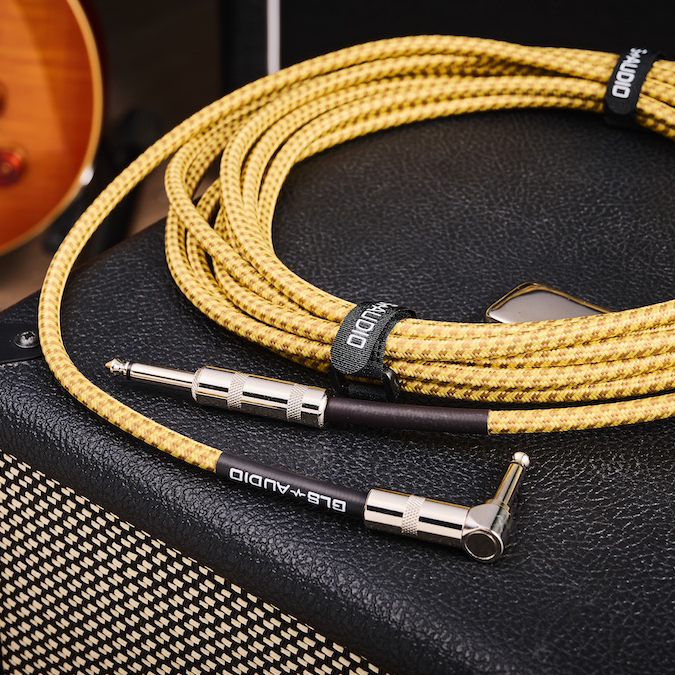
The Pickup Equation article buried a finding in its worked example that deserves to be its own headline: a 5m guitar cable contributes 400–600 pF of capacitance — several times more than the pickup's own internal capacitance. You've been playing through a tone control mounted inside your cable jacket this whole time, and it doesn't have a knob.
The Short Version
- A guitar cable isn't just a wire — it's a capacitor, formed by its center conductor and shield running the cable's whole length, and that capacitance sits directly in parallel with your pickup.
- Cable capacitance is often larger than the pickup's own capacitance. A 5m cable at 400–600 pF against a typical pickup's 200–250 pF internal figure means the cable is doing more work than the part you're actually paying attention to.
- More capacitance in that circuit pulls the resonant peak down and can make it broader, the same mechanism worked through in detail in The Pickup Equation — this article applies that mechanism specifically to the cable.
- A buffer breaks this relationship entirely. Once your signal has passed through a low-impedance buffer stage, the cable after it can no longer meaningfully load the pickup — the whole cable-capacitance effect only exists because a passive pickup is a high-impedance source.
- A long pedalboard chain of true-bypass pedals adds up cable capacitance at every hop, even with every pedal switched off — which is a real, underappreciated reason a heavily-patched true-bypass board can sound duller than the same guitar plugged straight into the amp.
What Everyone Gets Wrong
Cable shopping runs almost entirely on marketing language — "oxygen-free copper," "silver-plated," claims about directionality — none of which addresses the one property of a cable that's actually audible in a passive guitar circuit: its capacitance per unit length.
Why a cable has capacitance at all
Any two conductors separated by an insulator form a capacitor — that's the literal definition of the component, and it's exactly the mechanism The Pickup Equation uses to explain a pickup coil's own internal capacitance, thousands of turns of insulated wire lying against each other. A shielded instrument cable is built the same way at a larger scale: a center conductor carrying the signal, surrounded by insulation, surrounded by a shield (braided or foil) that's tied to ground. Center conductor and shield, separated by insulation — a capacitor, running the entire length of the cable.
Longer cable means more area of conductor facing more area of shield, which means more capacitance. This is why cable capacitance is quoted per unit length (commonly per foot or per meter) and scales roughly linearly with how much cable you're using.
Why it matters specifically for a passive pickup
This effect is nearly silent on a line-level or buffered signal, and enormously audible on a passive guitar pickup. The reason is impedance.
A passive magnetic pickup is a high-impedance source — it presents a relatively high source impedance to whatever it's connected to, which is exactly why The Pickup Equation treats "the pickup plus the guitar's electronics plus the cable" as one combined resonant circuit rather than analyzing the pickup in isolation. Any capacitance added downstream of a high-impedance source forms a low-pass filter with that source's own impedance — and the higher the source impedance, the more effective that filtering is, even from a relatively modest capacitance value.
A buffered or line-level signal, by contrast, comes from a low-impedance source, and the same cable capacitance barely interacts with it at all — which is exactly why nobody worries about cable capacitance between a buffered pedal's output and the next pedal in line, but everybody should worry about it between the guitar and the first thing it plugs into.
Running the Numbers
Applying The Pickup Equation's resonance formula, cable-first
Recall the mechanism from The Pickup Equation:
Where is the total capacitance in the circuit — pickup, pots, and cable, all added together, not the pickup's figure alone. Using that article's representative Telecaster-bridge values ( H, pickup capacitance 250 pF) with two different cable lengths:
A short, 3m cable at roughly 240–360 pF (using a representative 80–120 pF/m figure): total capacitance around 490–610 pF, resonance in the 2.9–3.2 kHz range.
A long, 9m cable at roughly 720–1080 pF: total capacitance around 970–1330 pF, resonance drops to roughly 2.2–2.6 kHz.
That's a real, audible shift — comparable in size to The Pickup Equation's own worked example of raising pickup capacitance directly, described there as making the tone noticeably "quackier" and less present up top. Cable length alone can move your tone as much as changing pickups, and it costs nothing but a shorter cable to test.
The pedalboard-chain compounding effect
Here's the part that's easy to miss: on a true-bypass pedalboard, a signal switched to "bypass" still physically routes through that pedal's input and output jacks and the patch cables connecting it to its neighbors, even though the pedal's circuit itself is out of the path. Every hop of cable between true-bypass pedals adds its own capacitance to the total, whether the pedals are engaged or not.
A pedalboard with six pedals in a true-bypass chain, connected by six short patch cables plus the cable to the amp, can easily accumulate more total cable length — and therefore more total capacitance — than a single long cable run would. This is a genuine, underappreciated reason a guitar can sound noticeably duller running through an elaborate true-bypass board, even with every single pedal switched off, than the same guitar plugged straight into the amp.
What This Means on the Bench
Buy the shortest cable that actually reaches. This is the single cheapest, most direct tone control available to a guitar player, and it costs nothing beyond buying appropriately rather than buying long "just in case."
If you must run a long cable or a large true-bypass board, put a buffer as early in the chain as practical. Once the signal is buffered, downstream cable length stops mattering for this specific effect — which is precisely why buffered pedals and buffered boards exist, and why "true bypass is always better" is a real oversimplification once cable capacitance enters the picture. A buffer isn't tone-neutral marketing puffery; it's solving a specific, measurable problem.
Low-capacitance cable is a genuine spec worth checking, not just a premium-cable marketing claim — a cable specifically built with lower capacitance per foot will measurably preserve more top end over the same length compared to a standard-capacitance cable, for exactly the reasons worked through above.
Don't chase this effect with EQ if you don't have to. A treble boost compensating for cable rolloff changes the whole spectrum's balance, not just the resonant peak's position — fixing the actual capacitance (shorter cable, lower-capacitance cable, or a buffer) addresses the specific mechanism rather than papering over it.
Try It Yourself
FET Playground is the right tool for understanding the buffer side of this story directly: a simple JFET or MOSFET buffer stage is exactly the kind of low-output-impedance circuit that breaks the cable-capacitance relationship described above. Design a common-source stage there and you'll see directly why its low output impedance makes downstream cable length a non-issue in a way a passive pickup's high impedance never can be.
For the full derivation of the resonance mechanism this article applies specifically to cables, The Pickup Equation is the foundational piece — read it first if the formula above needs more context than this article gives it.
Sources
- Cable capacitance figures (roughly 80–120 pF/m as a representative range for common instrument cable) are manufacturer-published specifications; individual products vary by nearly a factor of two, which is itself a meaningful tonal variable worth checking before buying.
- The resonance calculations here directly extend the worked example and component values established in The Pickup Equation, Resistance, Inductance, and Capacitance Demystified — see that article for the underlying pickup inductance and capacitance figures and their sourcing.
- The true-bypass pedalboard capacitance-compounding effect follows directly from cable-capacitance-per-length arithmetic; it is a straightforward consequence of the mechanism rather than a separately cited claim.