About

Marko Maletin

Use knowledge to empower your creativity — that's the whole project. Practical audio engineering and guitar sound, taught without the intimidation.


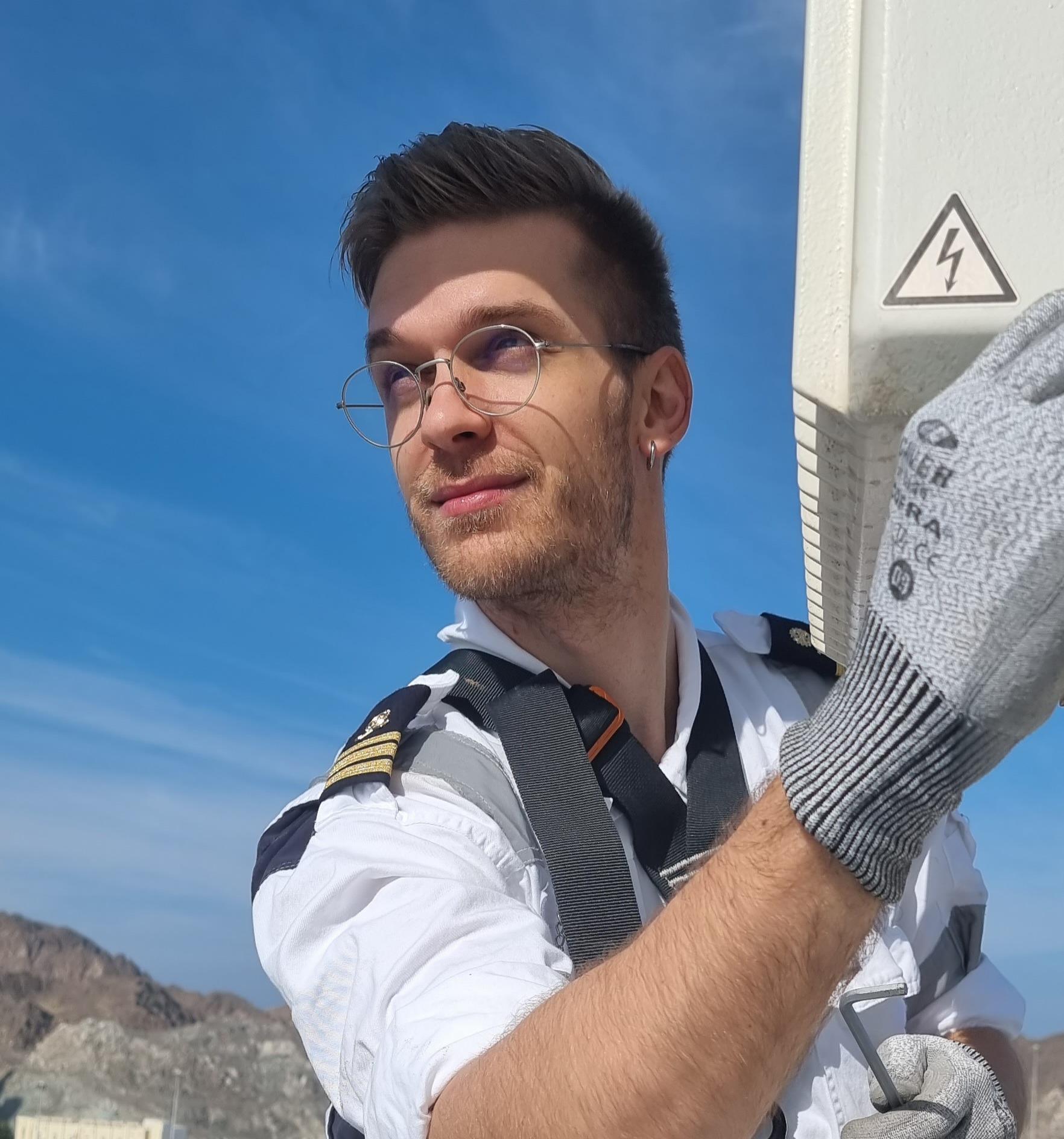
Marko Maletin working on an industrial electrical panel

Hey — I'm Marko. I'm an engineer and a musician, and Slightly Technical is what happens when those two refuse to stay in separate rooms.

I build vintage amplifiers and I love programming digital synths. That combination is not as contradictory as it sounds: understand what a circuit is doing to a signal and it stops mattering whether the thing doing it is a tube or a line of code. Most of the mystique around tone lives in the gap between those two worlds.

What you'll find here is the working notes: how I actually bias an amp, why a pedal sounds different on a battery, what a pickup's inductance really does to your top end. Real measurements, plain language, and no assumption that you already speak the jargon.

Hundreds of clients have had gear through my hands, and hundreds of students have been through this material in one form or another. If it helps you fix your amp or finally understand your signal chain, it's doing its job.


The work

Three things, one subject

Fixing gear, teaching how it works, and talking about it in public. They feed each other constantly — every repair becomes an article, every question from a student becomes a better explanation.

01

The bench

Repair, modification and rig building. Amps that hum, amps that died, and amps that work perfectly but sound wrong; pedals rebuilt around what a player actually asked for; whole rigs planned so the pieces stop fighting each other. More than a decade of professional audio work behind it — mixing consoles, amplifiers, signal processors and recording equipment, analog and digital alike — and hundreds of clients through it.

  • Repair
  • Mods
  • Rig building
  • Diagnostics

02

The classroom

Tone science, practical audio engineering, rig building, and the technical insight that turns “it sounds bad” into something you can measure and then fix. Hundreds of students so far — first through educational courses I wrote and taught, now through the tech pages, one-to-one coaching, and the app. The aim has never changed: replace “I can't” with “I can”.

  • Tone science
  • Audio engineering
  • Courses
  • Coaching

03

The channel

The podcast, the videos, and the social channels, in English and Serbian. Long-form conversations with players and engineers, teardowns, myth-checking, and the short stuff that lands one idea in ninety seconds. It is the same material as everything else here, cut to different lengths for people who find it in different places.

  • Podcast
  • YouTube
  • Instagram
  • TikTok

Background

Where the answers come from

Three formations, overlapping rather than sequential. The useful part is the overlap — a repair problem is often a musicianship problem, and a tone problem is frequently a measurement problem.

Trained

The engineer

Engineer's degree from the Faculty of Technical Sciences, University of Novi Sad — Computer Graphics Engineering, specialised in digital signal processing, with secondary study in electronics and telecommunications. That side keeps going in code: DSP and audio programming in C++, and years of building and running IT systems. It is why “analog versus digital” has never felt like a real argument to me.

Played

The musician

Over ten years in live music, from small club gigs to large stages, plus studio work. This is the reason the technical side never drifts into abstraction. Knowing what a circuit does to a signal and knowing what a player needs in a room are two different skills, and only one of them gets taught at university.

Tested

The pressure

Leading 30+ crew through shipyard refits aboard cruise vessels, running server rooms, and repairing safety-critical navigation and communication systems — work normally handed to outside contractors. Calm, systematic troubleshooting, on a deadline, with no option to walk away and think about it, was learned here.


How this works

Three things I try to hold to

From intimidation to inspiration

Technical audio work looks forbidding from outside. Almost none of it actually is — it just gets explained badly. Everything here is built to replace “I can't” with “I can.”

No hype, no mystification

A great deal of what circulates about tone is folklore repeated confidently. Where something is measurable, it gets measured. Where the popular explanation is wrong, that gets said plainly.

Curiosity over caution

Mistakes are how understanding actually arrives. The point is not to memorise fixes — it is to understand your gear well enough to work out the next one yourself.

Working on something specific and stubborn? I take a small number of one-to-one consultations →