Tech pages · Tubes · Guitar Amps · Measurement
Cathode Bias vs Fixed Bias: What Actually Changes
The Class A/Class AB label on your amp's box is very often wrong, and it isn't the thing that makes a cathode-biased amp feel different anyway. Here's what actually is.
My biasing article covers the output-transformer resistance method in detail, and it scopes itself deliberately to fixed bias, with a note that the 60–70% target doesn't transfer to a cathode-biased amp. This is the other half — what cathode bias actually is, why it idles so much hotter without cooking itself, and why the whole "Class A means better" thing on the box is, more often than not, simply wrong.
The Short Version
- Fixed bias sets the grid voltage from a separate, adjustable negative supply. Cathode bias sets it as a byproduct of the tube's own current flowing through a resistor. Same job, opposite mechanism.
- Cathode bias is self-regulating: if a tube starts drawing more current, the cathode voltage rises, which pulls the grid more negative relative to the cathode, which pulls the current back down. It is a built-in negative feedback loop around each tube.
- That is why cathode-biased amps are commonly run at 90%+ of maximum plate dissipation — a target that would cook a fixed-bias tube — and survive it. The self-regulation is doing real protective work.
- "Cathode bias means Class A" is usually false. Most cathode-biased guitar amps, including the Vox AC30, actually run Class AB — the tubes do go into cutoff during part of the waveform at real playing levels. True Class A in a guitar amp is rare and mostly shows up in small single-ended designs.
- The audible difference is supply sag and a soft, program-dependent compression, not "Class A magic." A cathode-biased amp's bias point moves with how hard you play, in real time, and that's the actual mechanism behind the feel.
- You cannot adjust a cathode-biased amp's idle current with a bias pot, because there usually isn't one — the resistor sets it, and changing it means changing the resistor.
What Everyone Gets Wrong
Ask a room full of guitarists what makes a Vox AC30 or a tweed Deluxe feel different from a Marshall, and "Class A, cathode bias, more tube feel" comes back almost every time. Two separate claims are being fused into one there, and the fusion is the problem.
Bias method (fixed vs cathode) is about how the grid voltage is generated. Operating class (A, AB, B) is about how much of the input waveform each tube conducts through. They are related but not the same thing, and conflating them is why "Class A" gets slapped on amps that provably are not.
How each one actually works
Fixed bias uses a dedicated negative supply — usually rectified and filtered off its own transformer winding — feeding a fixed or adjustable voltage to the power tube grids through large-value grid-leak resistors. That negative voltage sits there regardless of what the tube is doing. Set it once (or trim it with a pot), and it stays put until you touch it again. This is what the output-transformer resistance biasing method measures and sets.
Cathode bias does something structurally different: it grounds the grids (through a resistor, for RF stability) and instead lifts the cathode above ground with a resistor. Current flowing through the tube also flows through that resistor, developing a voltage across it. Since the grid is at ground and the cathode is above ground, the grid is negative relative to the cathode — which is all "bias" ever means. No separate negative supply required.
The self-regulation, and why it matters more than the label
Here's the part that actually explains the feel. In a cathode-biased stage, if the tube's current tries to rise — because a tube warmed up, because a replacement runs a little hot, because you're driving it harder — the cathode resistor's voltage rises with it. That rise makes the grid more negative relative to the cathode, which is exactly the correction needed to pull the current back down.
Cathode bias is a built-in negative feedback loop around each individual tube's operating point. No external circuit is doing this — it's a direct consequence of Ohm's law and where the resistor sits.
This is precisely why cathode-biased amps get run so much hotter as a percentage of maximum rated dissipation than fixed-bias amps do, and survive it. A fixed-bias tube biased too hot has nothing pulling it back — it will happily cook itself to destruction. A cathode-biased tube pulls its own leash tight as it heats up. That self-limiting behavior is the actual protective mechanism, and it's also — see below — most of what people are hearing as "feel."
Class A, Class AB, and the label on the box
Class A means every tube conducts through the entire input cycle, 360 degrees, all the time. Class AB means each tube conducts for more than half the cycle but less than all of it — they hand off, one picking up current as the other tails off, with some genuine overlap.
Whether a push-pull stage is Class A or Class AB is set by the idle current relative to the load line and the drive level, not by which bias method generated that idle current. A push-pull pair can be cathode-biased and still run Class AB at real playing volume, because as you push more signal in, one tube's grid swings hard enough to approach cutoff — at which point that tube stops conducting for part of the cycle, which is the literal definition of leaving Class A.
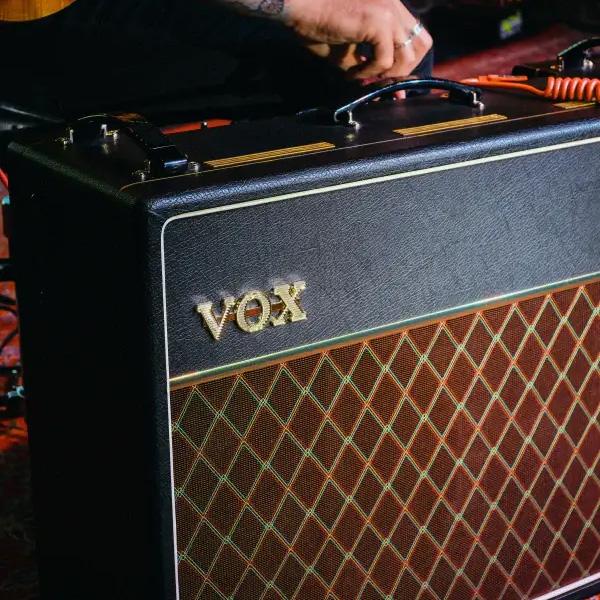
The Vox AC30 is the case study everyone cites as "the Class A amp," and depending on how hard it's driven, it does not stay in Class A at all — at real gig volume, the EL84 pair swings into genuine AB operation, tube handoff and all. It idles hot and cathode-biased, which is real and does matter, but the specific claim "it's Class A" is frequently just wrong once you look at what the tubes are actually doing above a whisper.
Genuine Class A guitar amps — where the tubes never leave full conduction at any real playing level — mostly show up in single-ended designs, where there's only one tube (or one paralleled group) and no handoff is even structurally possible. A single-ended 5W Champ-style amp is unambiguously Class A. A push-pull cathode-biased 30W combo, much less so, however the spec sheet phrases it.
Running the Numbers
Why 90%+ is normal for cathode bias and would cook a fixed-bias tube
The self-regulation above is the entire explanation. A fixed-bias amp's idle current is set once by an external voltage and does not correct itself — the standard target of 60–70% of maximum plate dissipation, covered in the biasing article, exists specifically because there's real headroom needed for the amp to safely run hotter under drive without the tube already sitting at its limit at idle.
A cathode-biased amp doesn't need that same margin, because the mechanism that would push it past a safe point is the same mechanism pulling it back. It's genuinely common and genuinely safe to see cathode-biased EL84 or 6V6 pairs specified to idle at 90% or more of maximum dissipation — a number that would be reckless in a fixed-bias design.
The resistor-and-Ohm's-law arithmetic
For a cathode-biased pair sharing one resistor, the cathode voltage is set by the total current through both tubes:
And the actual grid-to-cathode bias voltage each tube sees is simply that cathode voltage, since the grids sit at ground:
Which means, unlike fixed bias, you cannot dial in a specific idle current with a trim pot on a typical cathode-biased design — there usually isn't one. The resistor value is the bias setting. Changing the idle current means changing the resistor, full stop, and there's no in-circuit adjustment to sweep through while you watch a meter the way the fixed-bias method allows.
Worth being precise about what this means for measuring it, too: a cathode-bias reading is a voltage-across-a-known-resistor measurement, exactly like the fixed-bias transformer-resistance method — you're reading across and dividing to get current, not measuring plate voltage and current through a shunt in the high-voltage path. Same safety profile as the OT-resistance method, different node.
Sag, and why it's the real feel mechanism
Here's the thing actually responsible for the character difference people attribute to "Class A magic": cathode bias makes the operating point move in real time as you play, because the cathode voltage tracks total current draw dynamically, not just at idle.
Hit the strings hard, current draw rises, the cathode voltage rises with it, which pushes the tubes toward cutoff faster than a fixed grid voltage would — a genuine, self-imposed compression that happens on the millisecond timescale of your picking dynamics. Combine that with a smaller power transformer (common on cathode-biased combos, which tend to be lower-wattage designs to begin with) and you get supply sag on top of bias sag, compounding into the soft, "breathing" compression small cathode-biased amps are known for.
That's a real, measurable, mechanism-level effect. It has nothing to do with whether the amp is technically Class A, and everything to do with self-regulation happening in real time under a real signal.
What This Means on the Bench
Don't trust the Class A label on a spec sheet without checking the idle current against the load line at real playing levels. It's routinely applied to amps that are demonstrably Class AB once you push them.
If you're choosing a cathode resistor value for a mod or a build, budget dissipation headroom differently than you would for fixed bias. The self-regulation buys real margin, but the resistor itself has to handle real continuous power — a cathode resistor in a hot-biased EL84 pair is dissipating watts continuously and needs to be rated for it, not just for the voltage.
If an amp "feels compressed and alive" and you're chasing that on a fixed-bias design, look at power supply sag before reaching for tube swaps. Cathode-biased amps get a lot of that feel from a small transformer sagging under dynamic current draw as much as from the bias mechanism itself — the two effects are easy to conflate and worth separating when you're diagnosing what you actually like about an amp.
Cathode bias is not inherently "better" or "more vintage-correct." It's a different design tradeoff — self-regulating and forgiving of tube variance, at the cost of no in-circuit adjustability and generally lower efficiency (more of the tube's dissipation budget goes to idle heat rather than useful output). Fixed bias gives you precise control and generally more clean headroom for the same tube complement, at the cost of needing that control exercised correctly.
Try It Yourself
Bias Bench handles both methods natively — set up a cathode-biased pair with a shared sense resistor and watch how the tool derives per-tube current and dissipation the same way it does for fixed bias, from a voltage-across-a-known-resistance reading. Compare a cathode-biased EL84 pair targeted at 90% of maximum dissipation against a fixed-bias 6L6 pair at the usual 60–70%, and see just how different the safe operating margins really are between the two methods.
For the arithmetic behind measuring either one safely, how to bias a fixed-bias push-pull power amp is the companion piece — same measurement discipline, opposite bias mechanism.
Sources
- The self-regulating behavior of cathode bias (rising cathode voltage negatively correcting rising plate current) follows directly from the circuit topology and Ohm's law; it requires no external citation beyond the circuit itself.
- Class A / Class AB definitions (conduction angle relative to the full input cycle) are standard vacuum-tube amplifier theory.
- The claim that many commercially labeled "Class A" guitar amps, including cathode-biased EL84 designs, operate in genuine Class AB at real playing levels follows from comparing typical idle bias points against published tube transfer characteristics and realistic drive levels — this is a widely discussed point in amp-technician literature, not a controversial one, though manufacturers rarely correct the marketing language.
- Typical idle-dissipation percentages (60–70% fixed bias, 90%+ cathode bias) are working conventions from amp-repair and -building practice, consistent with the self-regulation argument above.