Tech pages · Guitar Amps · Electronics · Mods & Builds
What a Tone Stack Actually Does
Fender, Marshall and Vox all built the same three-knob EQ out of the same three parts. Why they don't sound remotely alike, and why the Middle knob is not like the other two.
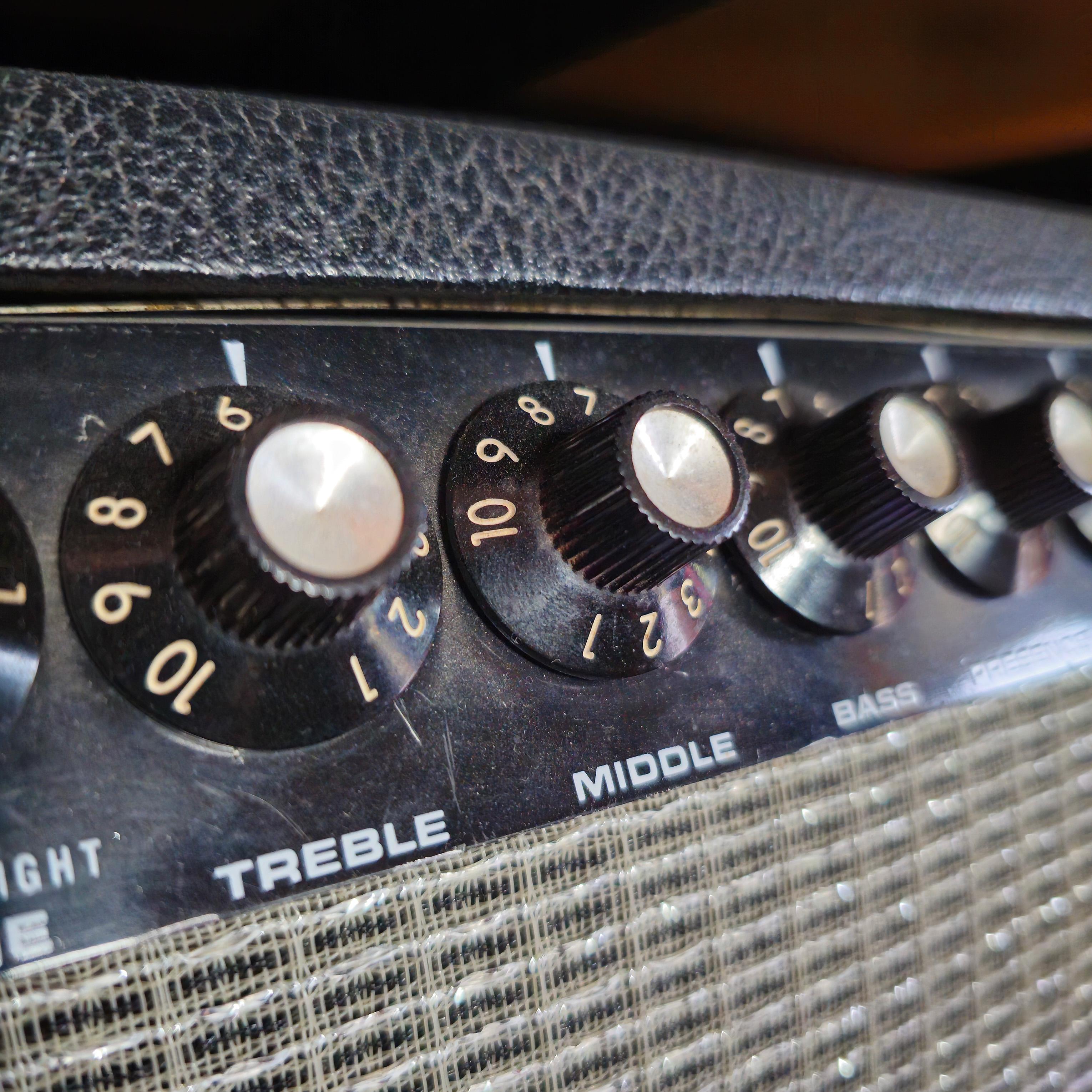
Five articles on this site now tell you to go "load this stack in Tone Stack Lab and look at the curve." None of them ever explained what you would be looking at. Time to fix that.
Here's the thing that should be a bigger deal than it is: the tone stack in a blackface Twin, a Marshall Plexi, and a Vox AC30 is the same three components, arranged the same way. A resistor, three capacitors, three pots. Same topology, right down to the wiring. And they produce three of the most different-sounding clean tones in the history of the electric guitar.
That is not a contradiction. It is the whole lesson.
The Short Version
- The stack is universally called FMV — Fender/Marshall/Vox — because all three built the same passive RC network, just with different component values.
- It is passive. It has no gain. Every setting either passes signal or throws part of it away, which is why a tone stack always costs you level, and why the input gain structure has to plan for that loss.
- The Middle control does not add midrange. Turning it up increases how much signal it shunts to ground. Zero mid = maximum mid content passed. This is backwards from every other control on the panel, and it trips up more people than any other fact about this circuit.
- Bass, Mid and Treble are not independent. They interact through shared nodes, so moving one changes what the others do. This is a property of the topology, not a flaw in any particular amp.
- Fender, Marshall and Vox land in wildly different places because of which values they chose, not because they used different circuits. The slope resistor and the treble cap alone predict most of the character difference.
- The "scooped mids" sound is not a myth or a preference. It is a real notch in the frequency response, and its depth is set by one specific resistor.
What Everyone Gets Wrong
People argue about tone stacks the way they argue about pickups — brand names, mystique, "this one just sounds better." All three controls are doing exactly what their component values say they will do, and the reason nobody can predict the outcome by ear is that the circuit does not behave the way three independent knobs would.
The whole confusion collapses once you see two things clearly: the network is passive, and the three controls share nodes.
It's passive, so it never adds anything
A tone stack has no active devices in it — no tube, no transistor, no op-amp. It is a resistor, three capacitors, and three potentiometers, arranged so that different frequency bands find easier or harder paths to ground. Nothing in that network can produce gain. At absolute best, at some frequency, at some knob setting, the stack passes signal through unattenuated. Everywhere else, it throws some of the signal away.
This has a consequence people rarely connect to the tone stack itself: the gain stage before the stack has to make up for a loss that the stack always imposes, even at "flat." A tube stage feeding an FMV network is not just providing gain — it is providing the headroom the stack is about to spend. This is why moving a tone stack's position in the signal chain (before or after a gain stage) changes an amp's whole character, not just its EQ.
The topology — one picture, three amps
Here is the shape, and it is worth sitting with because every FMV amp on earth is a variation of it:

Signal comes in through R1, the slope resistor — the single component most responsible for how much total level the stack eats, and how steep the rolloff is at the edges.
From there it splits three ways. A small capacitor, C1, taps straight to the Treble pot — high frequencies pass through easily because a capacitor's impedance falls as frequency rises, so C1 is a direct high-pass path to that control.
The rest of the signal continues to the Bass pot, a much larger-value potentiometer that behaves close to a simple volume control for the low end.
And sitting between the Bass network and ground is the Mid pot in series with C3, the mid cap. This is the part that catches everyone.
Why turning Mid up turns your mids down
The Mid pot's job in an FMV stack is not to boost anything. It is a shunt to ground. Its resistance sits in series with everything else going toward the ground rail, and how much resistance is in that path controls how much of the midrange gets bled off before it ever reaches the output.
- Mid pot at zero resistance (fully one direction, depending on the amp) → the shunt path is wide open → midrange drains to ground fast → you hear less mid.
- Mid pot at maximum resistance → the shunt path is nearly blocked → midrange has nowhere easy to go → you hear more mid.
Which direction is "up" on the physical knob depends on the amp's wiring convention, and that is exactly why this trips people up — the label says "Mid" and the intuition says "turning a knob clockwise adds more of the thing," and on this one control that intuition is fighting the actual circuit. Whichever way your particular amp wires it, the mechanism underneath is always: more resistance in that branch, less midrange lost, more midrange heard.
This single fact is also the whole story behind the famous Fender-versus-Marshall mid-scoop argument, which the numbers below make precise.
Running the Numbers
Time to put real values in, because the differences here are not vague — they come straight off factory schematics.
The classic scoop: Fender/Marshall (Bassman-derived) values
The Fender 5F6-A Bassman — the amp Marshall's JTM45 copied component-for-component before Marshall started changing values — uses:
Marshall's own 1959 Super Lead and the JCM800 2203 use the same shape with a smaller slope resistor and slightly different caps:
Set all three controls to noon on either of these and you get a pronounced notch centred in the low-to-mid midrange — commonly cited around 300–500 Hz depending on the exact values — with the bass and treble both sitting proud of it. That notch is not subtle. It is why a Marshall or a tweed Bassman has "room" for a vocal to sit in even at full volume: the frequencies a voice occupies are the ones this network is built to remove.
This is the real mechanism behind "scooped mids." It is not a myth, not a preference, not a marketing term. It is a resistor-and-capacitor notch filter, and the depth of that notch is controlled almost entirely by the mid pot's maximum value — a 25k mid pot digs a deeper notch than a 10k one, all else equal, because there is more resistance available in the shunt path to protect the midrange when the knob is backed off, but also more available to dump it when the knob is at its other extreme.
Fender blackface: a different animal, hiding under the same name
Here is the surprise. The blackface circuit — Twin Reverb, Deluxe Reverb, Princeton Reverb — is routinely lumped in with the tweed Bassman as "the Fender sound," and at the tone-stack level it is not the same circuit's values at all:
Nearly double the slope resistor. Bass and mid caps both substantially larger. And on the two smallest amps in the family — the Deluxe Reverb and the Princeton Reverb — there is no mid pot at all. In its place sits a fixed 6.8k resistor. The mid control was deleted, and what remains permanently dials in a specific, moderate amount of midrange loss that can never be adjusted from the front panel.
The Twin and the Super Reverb keep a mid pot, but a much smaller one — 10k, against the Bassman's 25k. Less mid pot means a shallower possible scoop: even fully backed off, a blackface stack cannot dig the deep, hollow notch a tweed or Marshall stack can. This is the actual, component-level reason a blackface Fender sounds fuller and more present in the midrange than a scooped Marshall, even before you touch a single control — the two circuits are not capable of the same notch depth, full stop.
Vox: leave the Fender/Marshall assumptions at the door
Vox's Top Boost circuit (AC30, AC15) keeps the FMV topology and throws out every value association you might have built from the amps above:
That treble cap is a fifth of the Bassman's and a tenth of the Marshall's — 50 pF against 250–500 pF. Combined with a treble pot four times larger than a Fender's, the whole treble response moves dramatically higher in frequency and becomes far more surgical: small movements of the Vox Treble control do much less at guitar frequencies than the same movement on a Marshall, because the corner it is shaping sits so much further up the spectrum.
And the AC30 has no mid pot whatsoever — its Bass pot is wired to ground directly rather than through a separate mid network, an arrangement the FMV family calls a grounded-bass variant. The AC15's Top Boost channel instead uses a fixed 220k in the mid position — two orders of magnitude larger than anything in the Fender or Marshall family, which barely functions as a shunt at all. Vox is not scooping mids. It structurally can't, on this channel, and that is a huge part of why an AC30 sounds so different beside a Marshall running the identical topology.
Why three knobs can't move independently
Look again at the topology diagram. The Bass pot, the Mid network and the Treble path all connect back to shared nodes — they are not three separate filters bolted together, they are one network with three adjustable elements inside it.
Practical consequence: turning up the Bass control changes how much signal is available for the Mid and Treble paths to work with, because more bass energy reaching that shared node changes the impedance the whole network presents at other frequencies. This is why "turn the mid up and it sounds thin" or "the treble does something different depending on where bass is set" are not amp faults or your imagination — they are exactly what an interactive passive network is supposed to do. A tone stack is not an equalizer with three independent bands. It is a single circuit with three access points into it.
What This Means on the Bench
If you want a deeper scoop, look at the mid pot's maximum value before you touch anything else. A 25k mid pot digs deeper than a 10k one in the same topology. This is the single highest-leverage number in the whole network for "more Marshall, less Fender."
If you want a fuller, more present midrange without losing your amp's basic character, raise the mid pot's value rather than fighting the knob. The Blues Junior rework does exactly this — swaps in the Twin's larger bass and mid caps, moving a mid-forward stock voice toward blackface openness, without touching the topology at all.
Chasing a Vox-style top end by changing your Marshall's treble cap alone will disappoint you, because the AC30's brightness is a combination of a tiny treble cap and a huge treble pot working together — copy one without the other and you get an odd, narrow-band result rather than genuine Vox sparkle.
Remember the level loss. Every FMV stack throws away signal, worst at the "flat" setting most players never question. If an amp's clean channel feels quiet or its drive channel feels oddly polite, check what's happening in the stack before assuming the preamp needs more gain — sometimes the fix is moving the stack, not the tubes around it.
Try It Yourself
This entire article is a description of things you should be looking at rather than reading about, so go and look. Open Tone Stack Lab, load the Fender Bassman 5F6-A preset, and watch the notch appear as you bring the Mid control down from noon. Then load the Vox AC30 Top Boost preset next to it and watch how differently the Treble control behaves — same knob, same topology, a completely different piece of the spectrum under your finger.
For the deepest version of the lesson, load a Deluxe Reverb — no mid pot at all — beside a Twin Reverb, which keeps a small one. Same amp family, same era, and the Deluxe simply cannot reach the same scoop the Twin can. That is not a subjective amp-forum opinion. It is a 6.8k fixed resistor versus a 10k variable one, and the tool will show you exactly what those parts are worth.
If your interest here is amp mods specifically, Building Better Pedals covers the same resistor-and-capacitor thinking applied to stompboxes, and the bias math that decides how much headroom a preamp has to spend on a stack like this lives in how to bias a fixed-bias push-pull power amp.
Sources
- Component values for the Fender 5F6-A Bassman, Marshall 1959 Super Lead, Marshall JCM800 2203, Fender Twin/Deluxe/Super/Princeton Reverb (AB763/AA1164), and Vox AC30/AC15 Top Boost are schematic-verified figures maintained in Tone Stack Lab's own preset library, cross-checked against the original factory drawings during that tool's development.
- The JTM45's derivation from the 5F6-A Bassman circuit is well documented amp history; Marshall's early component substitutions and later value changes are visible directly in the schematic progression from JTM45 through the 1959 and into the JCM800 series.
- The "FMV" naming (Fender/Marshall/Vox) is the standard term used across amp-technician literature for this specific passive topology, distinguishing it from active tone stacks and from other passive families such as the Baxandall.
Same three parts, three completely different amps. Understand the resistor and the two capacitors doing the real work, and every "why does X sound like X" question about clean guitar tone gets a lot less mysterious.