Tech pages · Speakers & Cabs · Guitar Amps · Electronics · Measurement
Why Reactive Loads Sound Different From Real Cabinets
A speaker's impedance curve becomes your amp's frequency response. Here is the arithmetic that shows why — and why a reactive load plus an IR can count the same bump twice.
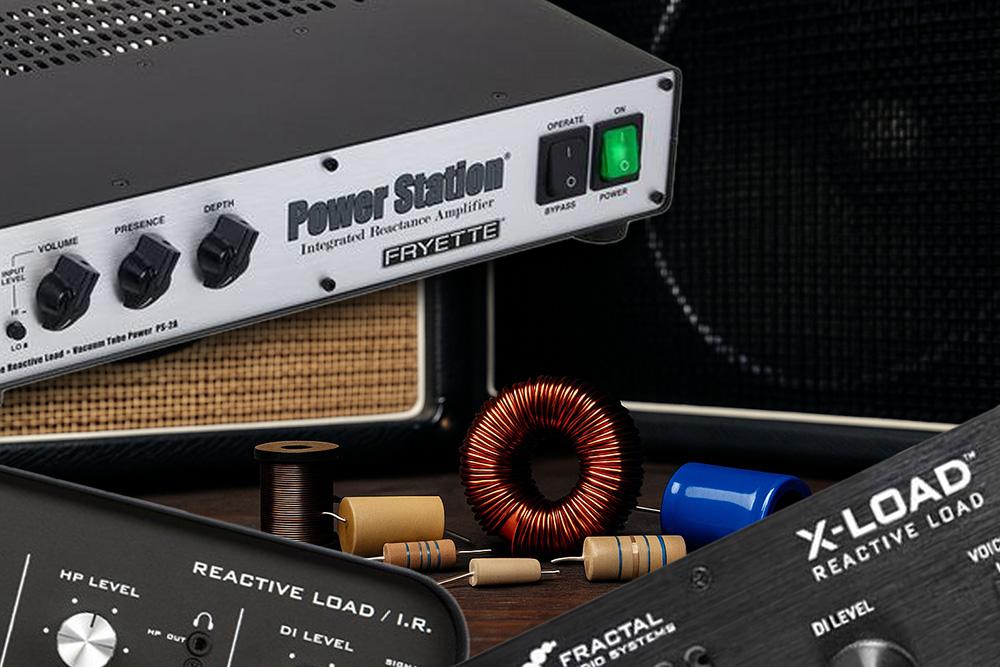
Reactive loads have gone from a specialist studio item to something half the people I know own. Silent recording, sane stage volume, the same tone at every gig — the pitch is genuinely good, and mostly it delivers.
What has not kept up is the understanding. There is a lot of talk about reactive loads "preserving the amp's interaction with the speaker," which is true but explains nothing, and quite a lot of confident advice about pairing loads with impulse responses that is actively wrong.
So let me do the thing I always want to do: show the mechanism, with numbers, and then let the practical advice fall out of it.
The Short Version
- A speaker's impedance is not flat. It peaks hard at the cabinet's resonance — often over 40 Ω on an "8 Ω" cab — and rises again in the treble from voice-coil inductance.
- That impedance curve becomes your frequency response, because your amp has a non-zero output impedance and the two form a divider. The maths is at the bottom of this article's middle section and it is three lines long.
- How much it matters depends entirely on your amp's damping factor. On a zero-feedback amp like a Vox AC30, a resonance peak can be worth 4 dB or more. On a heavily fed-back Hiwatt, under 1 dB.
- Reactive loads reproduce the curve. They do not reproduce the motion — thermal compression, changing damping with excursion, back-EMF from a cone that is actually moving.
- Load curve plus IR can double-count. An IR already contains the frequency response of a real amp driving a real cab. Stack a strongly-voiced reactive curve underneath and you get the resonance bump twice.
What Everyone Gets Wrong
The mistake is thinking of the load as a destination — a thing the amp pushes power into, which can be more or less accurate. A speaker is not a destination. It is a component in the circuit, and swapping it changes the circuit.
A speaker's impedance is a curve, not a number
The "8 Ω" on the back of your cab is a nominal figure. Real impedance varies enormously across the audio band:
- At low frequencies, near the driver's resonance, impedance climbs to a sharp peak. This is mechanical: the cone and suspension have a mass-spring resonance, and at that frequency the moving system fights back hardest. For guitar drivers this typically lands somewhere between 50 and 100 Hz free-air, and the cabinet moves it.
- Above resonance the impedance drops to its minimum, which is roughly the voice coil's DC resistance and usually well below the nominal rating — an "8 Ω" speaker often measures 6 Ω or so here.
- Through the treble the impedance rises again, this time from the voice coil's own inductance.

The enclosure then rewrites the bottom end of that curve, and this is where cabinet types separate:
- A sealed cab adds air stiffness behind the cone, which raises the resonant frequency above the driver's free-air figure and gives a single, well-defined peak.
- An open-back cab barely loads the driver at all, so the peak sits lower, closer to free air, and tends to be broader.
- A ported cab produces two peaks with a dip between them, the dip sitting at the port tuning frequency. This is the giveaway that you are looking at a reflex enclosure.
The bit that actually explains everything
Here is the mechanism, and I genuinely think it is the most useful thing in this article.
Your amplifier is not an ideal voltage source. It has an output impedance, , and it forms a voltage divider with the load:
Look at what that means. is not a constant — it is the curve above. So wherever the speaker's impedance is high, more of the amp's voltage lands on the speaker, and it gets louder. The impedance peak is a frequency response bump. Not metaphorically. Arithmetically.
How big a bump depends on , which is usually quoted as damping factor:
Let's do it twice, on a cab whose impedance runs 8 Ω in the midrange and 40 Ω at resonance.
A zero-feedback tube amp, where is around 8 Ω — damping factor 1:
A heavily fed-back amp, where is around 1 Ω — damping factor 8:
Same cabinet. Same impedance curve. Four and a half decibels of low-end bloom on one amp, less than one on the other. Nothing about the speaker changed; the amplifier's output impedance decided how much of the speaker's character it was willing to hear.
That single calculation explains most of the arguments people have about cabs, loads and "amp interaction."
Running the Numbers
How a reactive load fakes the curve

A reactive load builds an electrical network that traces the same shape:
- A capacitor, with an inductor, forms the resonant circuit that reproduces the low-frequency peak.
- An inductor in series produces the rising high-frequency impedance, standing in for voice-coil inductance.
- Resistors set the mid-band impedance and dissipate the actual power as heat.
Designers arrive at the values by measuring real speakers in real cabinets and fitting a network to the plot. Which immediately raises the question nobody asks in the shop: which cabinet?
Different loads model different cabs
Every cabinet has its own impedance fingerprint. A sealed 4×12 of Vintage 30s does not behave remotely like a single Jensen in an open-back combo, and a reactive load is a frozen copy of one of them.

Figure 3 is the reason this matters: these are supposed to be doing the same job and they are visibly not the same curve. Some products are explicit about what they model and some are not:
- Suhr Reactive Load is voiced around classic British 4×12 behaviour.
- Fractal Audio's X-Load offers switchable impedance curves rather than a single fixed one.
- Two Notes Torpedo Captor X bundles the load with an IR loader, EQ and headphone out.
- Fryette Power Station is a reactive load and a power amplifier, so it reamplifies rather than just absorbing.
- Weber MASS takes a different route entirely, using a real speaker motor as the load element — which gets it closer to the behaviours below than a passive network can.
Feed the same amp into two of these and it will genuinely be a different amp, for exactly the divider reason above.
What a reactive load cannot do
The curve is the easy part. What a passive network cannot reproduce is that a real speaker is a machine in motion, and its impedance changes while you play.
- Voice coil heating. Push a speaker hard and the coil's resistance climbs — a hot coil can be tens of percent above its cold value. That is thermal compression, and it is a large part of why a cranked cab sounds compressed in a way a load box does not.
- Excursion-dependent damping. As the cone travels further, the suspension's compliance and the magnetic gap's linearity both change. The resonance shifts and its Q changes while the note decays.
- Back-EMF. A moving cone is a generator. It produces a voltage opposing the drive signal, and that voltage feeds back into the amp's output stage — which, per the divider above, an amp with low damping factor is very exposed to. A passive RLC network is not a generator and produces none of this.
A reactive load is a static model. It reproduces one impedance curve, frozen at one moment, at one level. Everything above is dynamic and level-dependent, and that is the honest answer to "why doesn't it feel the same."
What This Means on the Bench
The IR double-counting trap
This is the practical mistake I see most, and it follows directly from the divider.
An impulse response already contains the impedance interaction. An IR is captured by miking a real cabinet, driven by a real power amp, and capturing what came out. Whatever bump that amp's output impedance produced at the cab's resonance is baked into the IR.
Now put that IR after a reactive load with a strongly voiced resonance of its own. The load bumps your amp's output at resonance. The IR bumps it again. You have counted the same physical phenomenon twice, and you end up wondering why everything is boomy at 90 Hz and blaming the cab sim.
The way out is to decide where you want the cabinet's character to come from:
- Let the IR do it. Use a load with a flatter, more neutral impedance and let the IR carry the voicing. Most flexible, and the safest default if you swap IRs a lot.
- Let the load do it. Match the load's model to the IR's cabinet, so at least the two bumps are in the same place and you are only exaggerating rather than smearing.
What you should not do is pick a strongly-voiced load and an unrelated IR and expect them to add up to a cabinet.
Not every amp cares equally

Which brings us back to damping factor, because it means the same reactive load is a bigger decision on some amps than others.
- Vox AC30. No global negative feedback loop at all. That leaves the output impedance high, damping factor near or below 1, and the amp maximally exposed to whatever curve you hand it. An AC30 will tell you which load you plugged into from across the room.
- Marshall Plexi and JCM800. Moderate feedback, so moderate damping — and enough gain and transformer character that the load still colours things audibly.
- Hiwatt DR103 and blackface Fenders. Heavy negative feedback, low output impedance, high damping factor. Comparatively indifferent to load variation, which is exactly what those designs were going for.
So "does a reactive load change my tone a lot" has a real answer, and it is: look at how much negative feedback your amp uses.
Buying one
Five things, in the order I would actually check them:
Power handling. Overspecify. A load rated at 100 W is not a comfortable home for a cranked 100 W head, because the whole point of the earlier article on output power is that a cranked 100 W amp is not making 100 W — it is making up to twice that. Check whether the rating is continuous or peak, and whether there is any thermal protection at all.
What it models. If the manufacturer will not tell you, that is information. Prefer documented curves, or switchable ones.
Transparency versus voicing. Decide which job you want it to do — see the IR section above — and buy accordingly rather than buying whichever is fashionable.
Features you will actually use. Built-in IR loading, EQ and a headphone out are genuinely convenient and genuinely lock you into one manufacturer's signal chain.
Build and cooling. Large inductors and power resistors get hot. Metal enclosure, real jacks, somewhere for the heat to go.
Try It Yourself
Everything in the mechanism section — output impedance, damping factor, cabinet resonance, how much of the curve reaches the speaker — is what Feedback Lab exists to show. Load the Vox AC30 preset, which is a genuine zero-feedback amp and sits at 0.000 dB of feedback by design, then load a Hiwatt or a Bassman next to it and switch the cabinet model between them. The response at the speaker moves dramatically on one and barely twitches on the other. That is the 4.4 dB versus 0.8 dB calculation above, drawn.
On your own bench: if you have an impedance meter, measure your actual cab. Most people have never seen their own cabinet's curve and are surprised by how far from 8 Ω it spends its life. If you don't, the cheap version is to feed the amp a sine sweep at low volume into the real cab and then into the load box, and record both. The differences will be exactly where the impedance curves disagree.
Sources
- Impedance behaviour of sealed, open-back and ported enclosures follows standard loudspeaker theory; the two-peak signature of a reflex enclosure is diagnostic and easy to verify with any impedance meter.
- The Vox AC30's lack of a global negative feedback loop is a design fact of the circuit, and is why it appears in Feedback Lab as a deliberate zero-feedback reference case at exactly 0.000 dB.
- The Hiwatt DR103's heavy feedback, taken from the 16 Ω tap on many early units, is visible on the factory schematic.
- The divider and damping-factor calculations use round numbers (8 Ω nominal, 40 Ω at resonance, of 8 Ω and 1 Ω) chosen to make the arithmetic legible. Real figures vary; the mechanism does not.
- Figure 3's comparison was measured with a Dayton Audio DATS. Product descriptions above reflect what each manufacturer documents — where a manufacturer does not publish a curve, I have not invented one.
Know what you're buying. It's Slightly Technical — but it makes all the difference.