Tech pages · Tubes · Guitar Amps · Speakers & Cabs · Measurement
Output Transformers and Impedance Matching Explained
Why an unplugged speaker can kill a tube amp in seconds, why the impedance selector actually matters, and what a solid-state amp's 'minimum load' rating really protects.
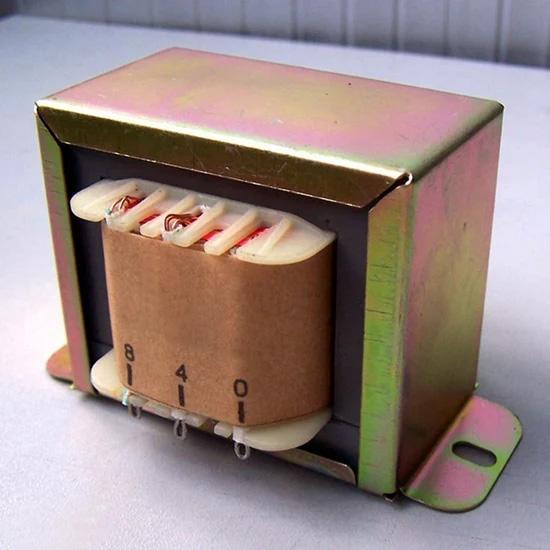
I promised this one at the end of the output-power article, where I deliberately left the whole subject of amplifier architecture alone. Time to pay that off.
Why does an unplugged tube amp die in seconds, when a solid-state amp is usually fine? What is the impedance selector actually selecting? And what does "minimum load 4 ohms" on a solid-state amp really mean? Three questions, one component sitting at the center of all of them.
The Short Version
- A tube's plate wants to see a high impedance load — thousands of ohms — to develop useful voltage swing. A speaker is a low impedance load — a handful of ohms. The output transformer's entire job is bridging that gap.
- Impedance transforms with the square of the turns ratio: . This is why small turns-ratio changes produce large impedance changes, and why the impedance selector matters more than it looks like it should.
- Running a tube amp with no speaker connected is the most dangerous mismatch of all — not because nothing happens, but because the primary tries to develop enormous, uncontrolled voltage spikes that can arc and destroy the transformer's insulation.
- A mismatched-but-connected load is usually survivable, just suboptimal — the wrong power transfer, more distortion, changed damping — as long as it isn't wildly wrong for extended periods at full power.
- Solid-state "minimum load" ratings protect the output devices from excess current, not the amp from an open circuit. The mechanism is the opposite of a tube amp's danger, which is exactly why the warnings sound similar but mean different things.
- The impedance selector is not a formality. Set it wrong and you get real, measurable changes to gain, damping factor and headroom — not just "a slightly wrong number on a dial."
What Everyone Gets Wrong
The instinct people have is that impedance matching is a minor technical footnote — get it roughly right and move on. It's the opposite: it's the mechanism that makes a tube power amp work at all, and getting it wrong in one specific direction is the single fastest way to destroy an output transformer.
Why a transformer has to be there in the first place
A power tube's plate characteristic wants a load impedance in the thousands of ohms to swing voltage efficiently and develop real power without the plate voltage collapsing under current draw. A speaker voice coil is a few ohms. Connect a speaker directly to a power tube's plate and almost nothing useful happens — the tube can't develop meaningful voltage swing into such a low impedance, and almost all its available power gets wasted rather than delivered.
The output transformer solves this with turns ratio. A transformer with times more turns on the primary than the secondary transforms impedance by the square of that ratio:
So a transformer built to present, say, 4,000 Ω to the tubes when an 8 Ω speaker is connected on the secondary needs a turns ratio of:
Roughly 22 primary turns for every 1 secondary turn. That's the entire mechanism. Everything else in this article is consequences of that one relationship.
Why the squared relationship matters so much
Because impedance scales with the square of the turns ratio, a modest change in effective turns ratio produces a large change in reflected impedance. This is precisely why an amp's impedance selector — which changes which transformer tap the speaker connects to, effectively changing — has such an outsized effect. Move from the 8 Ω tap to the 4 Ω tap on the same transformer and you've roughly halved the effective turns ratio on that leg, which means the plate impedance the tubes now see has dropped by a factor of two, not a small nudge.
Running the Numbers
What happens with no load at all
This is the dangerous one, and worth understanding precisely rather than just obeying the rule.
With a speaker connected, current flows through the transformer's secondary, and the transformer's own magnetizing behavior stays reasonably well-behaved because there's somewhere for the energy to go. Disconnect the speaker entirely and the secondary is open — no path for current, nowhere for the transformer's stored magnetic energy to be delivered.
Every time a power tube's current changes — and it's changing constantly, following the audio signal — the transformer tries to maintain the current through its windings by generating whatever voltage it takes to keep that current flowing (this is just Faraday's law: , and with the secondary open, there's no load to absorb the energy, so the voltage spikes to try to force it somewhere). With an open secondary, that voltage has no useful path, and the primary can develop extremely high voltage spikes — multiples of the normal plate voltage, sometimes high enough to arc across the transformer's own winding insulation internally.
That internal arc is what actually destroys transformers this way. It's not a gentle failure; it can carbonize the insulation between winding layers, creating a permanent short that ends the transformer's life in the same instant. This is why "never run a tube amp without a load" appears as a flat rule in every biasing and repair article on this site, with no qualification — it isn't caution for caution's sake, it's a specific, well-understood failure mechanism.
What happens with the wrong load (but a load)
This is a different and much less dramatic situation. Connect an 8 Ω speaker to a 4 Ω tap, or a 4 Ω speaker to an 8 Ω tap, and the transformer still has somewhere for the energy to go — it's just the wrong turns ratio for that impedance, so the tubes see a plate impedance that's off from their optimal load line.
Too high a reflected impedance (speaker impedance higher than the tap is designed for) generally means the tubes are being asked to swing more voltage than ideal for the available current, which can mean somewhat reduced power output and can increase peak voltage stress on the tubes — worth avoiding for extended periods at full power, but not the catastrophic open-circuit scenario above.
Too low a reflected impedance (speaker impedance lower than the tap) means the tubes see less load resistance than intended, which tends to increase current draw and can push dissipation higher than intended at a given drive level — again, not instantly destructive, but not something to run at full tilt indefinitely either.
Both cases also change the transformer's turns ratio relative to what the design assumed, which changes the feedback loop's takeoff voltage if the amp takes negative feedback from a speaker-jack tap — a mismatched load doesn't just change power transfer, it can subtly change the amp's damping and feel too, because so much of an amp's character downstream of the phase inverter runs through this one component.
The impedance selector, properly understood
An amp's front-panel impedance selector isn't picking a "mode" — it's physically routing the speaker connection to a different tap on the same transformer, which means a genuinely different turns ratio and a genuinely different reflected plate impedance for the exact same physical speaker.
Set a 4 Ω speaker cabinet to the amp's 8 Ω tap by mistake, and the tubes are now seeing a plate impedance that's double what a correctly-set 4 Ω tap would present. That's not a minor labeling error — it's the same magnitude of consequence as the mismatched-load scenario above, deliberately engineered into a front-panel control that's easy to leave in the wrong position after a cab swap.
What This Means on the Bench
Never power up a tube amp without a load connected, full stop, no exceptions for "just checking something quickly." This is the one rule on this site stated with zero qualification, because the failure mode is fast, often silent until the transformer is already gone, and expensive to fix.
Set the impedance selector to match your actual speaker load before you play, not after. A quick cab swap without rechecking the selector is one of the most common preventable mistakes on a working amp tech's bench.
A brief, moderate mismatch is not the same emergency as an open circuit. Plugging into the wrong tap for a few songs at a gig is a "fix it at the next break" problem, not a "power down immediately" one — but don't make a habit of it, and never combine a mismatch with cranked, sustained full power.
Solid-state minimum-load ratings are a different mechanism entirely, worth not confusing with the tube-amp rule above. A solid-state power amp has no transformer standing between its output devices and the speaker in the same way — the output stage drives the load more or less directly. A "minimum load 4 Ω" rating exists because lower impedance means higher current draw for the same voltage swing, and the output transistors have a maximum safe current they can pass before they're damaged by heat or by exceeding their safe operating area. Go below the rated minimum impedance and you risk too much current, not an open-circuit voltage spike — the opposite failure direction from the tube-amp no-load scenario. This is exactly why a solid-state amp is generally fine (though not ideal) run briefly with no speaker at all — no load means minimal current draw, not a dangerous spike — while a tube amp is fine loaded a bit wrong and dangerous loaded not at all. The two technologies' danger zones are, in a real sense, inverted.
Try It Yourself
The consequence of a mismatched load on an amp's damping and feedback behavior is exactly what Feedback Lab makes visible — load a preset, then look at what changing the effective load impedance does to the response at the speaker and the closed-loop damping factor. That's the mismatched-tap scenario from this article, drawn out rather than described.
For the bias-point side of a power stage — what the tubes are actually doing at idle before any of this transformer behavior even enters the picture — how to bias a fixed-bias push-pull power amp covers the measurement, and cathode bias vs fixed bias covers the other biasing family.
Sources
- The impedance-transforms-with-turns-ratio-squared relationship () is standard transformer theory.
- The open-secondary voltage-spike failure mechanism follows from Faraday's law applied to an inductor with no load path for its stored energy — standard transformer and inductor behavior, and a widely documented cause of output-transformer failure in tube-amp repair literature.
- The distinction between tube-amp no-load danger and solid-state minimum-load ratings reflects the fundamentally different output topologies: transformer-coupled (tube) versus direct-coupled (most solid-state) output stages.